Riverdale, GA · Garage Door Service
When Jonesboro's 1960s-70s Openers Finally Quit
Jonesboro's garage doors date mostly to 1968, inside the service area's 1960s-70s stock. We drive the 4 miles from Riverdale to fix aging chain-drive openers.
- Repairs & new doors
- Springs & openers
- Serving 7 nearby communities
Parts We Carry
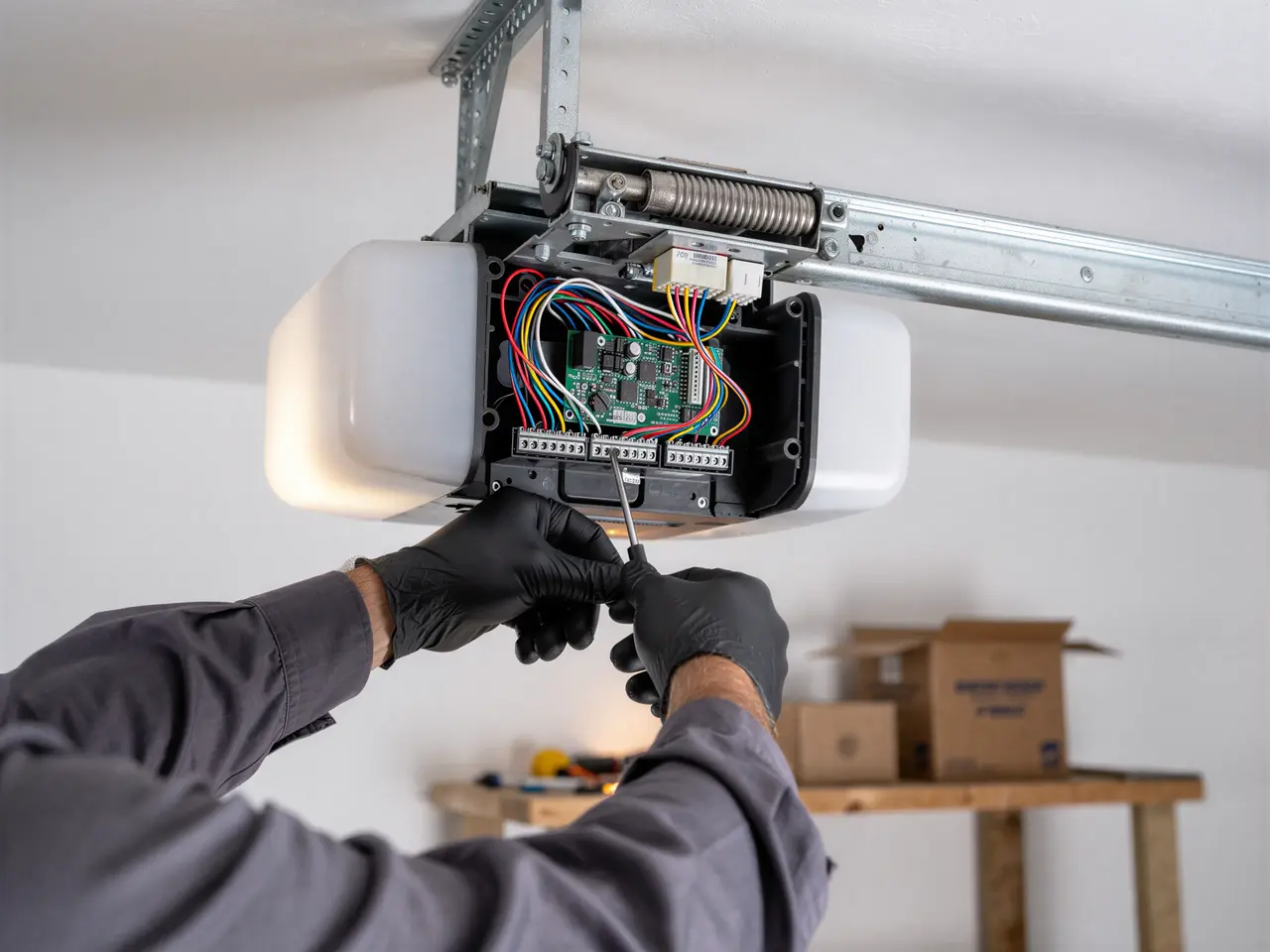
Jonesboro's homes carry a median build year of 1968, which puts most of the town squarely in the 1960s-70s cohort that makes up the bulk of the areas we cover out of Riverdale. That era means chain-drive openers more often than belt, older capacitor-style motor starts, and circuit boards that predate today's rolling-code remotes. We keep gear-and-sprocket kits, drive capacitors, safety-reversal sensors, and universal remotes on the truck because those are the parts that actually fail on houses this age.
What we don't carry for every call is a board built for a defunct brand's 1970s logic unit. Some of those went out of production decades ago, and if a repair calls for one, we order it rather than guess with a mismatched part. That's usually a day or two, not a same-visit fix, and we'd rather tell you that up front than swap in something that half-works.
Screw-drive units show up less often here than chain-drive, but we stock rail lubricant and drive screws for the ones that do. If your opener still has a keyed wall switch instead of a keypad, that's consistent with the original installation age for this part of town, and we treat it as a sign to check the whole unit, not just the switch.
Why This Fails Locally
An opener installed when a Jonesboro house was new in the late 1960s is now running on gears, bearings, and a logic board that have been cycling for over fifty years. That's not a defect, it's just the math of the housing stock here lining up with the service area's broader 1960s-70s building wave. The parts wear in a predictable order: nylon drive gears strip first, then the capacitor that gets the motor started weakens, then the safety-reversal sensors drift out of alignment.
The climate band this area sits in is cold-moderate, which means real winter swings rather than a flat mild year. That matters for belt and chain tension - cold tightens steel chain and makes old grease stiff, so a door that closes fine in August can bind or reverse on its own in January. On a house with original 1960s hardware, that seasonal swing is often what finally pushes a marginal opener into failure rather than causing it outright.
We see this pattern often enough on this side of the service area that when a call comes in from Jonesboro, we're already thinking gear wear and sensor drift before we've seen the unit.
What the Repair Takes
Jonesboro sits four miles from Riverdale, which is close enough that a call here doesn't need a separate dispatch or a different truck load. We load the gear kits, capacitors, and sensors suited to this town's building era before we leave, the same way we would for a Riverdale address, because the housing stock and the failure patterns overlap that closely.
The short drive also means we're not burning the visit on travel. Diagnosis starts with the obvious: does the motor hum without moving the door (usually a stripped gear), does it reverse before closing (usually a sensor or a limit setting), or does it not respond at all (often the capacitor or the board). On a fifty-year-old opener, we check the whole chain of parts rather than just swapping the piece that failed, because a gear that stripped under strain from a dragging track will strip the replacement too if the track isn't addressed.
We don't replace a working motor just because the unit is old. If the gear and capacitor are the problem and the rest of the unit is sound, we fix what failed and leave the rest alone.
The DIY Question
Jonesboro's median household income runs $50,060, noticeably below the wider service area's $67,872, and that gap is real in how people decide whether to call someone or try it themselves first. Some opener fixes are genuinely fine to do yourself: reprogramming a remote, cleaning photo-eye sensor lenses, tightening a loose bracket. Those take a screwdriver and ten minutes.
What we don't recommend doing yourself is anything touching the safety-reversal circuit or the main logic board. Those parts exist so the door doesn't close on something, and a miswired fix there is the kind of thing that looks fine until it isn't. We also don't recommend replacing a drive gear without checking spring tension first - a motor straining against an unbalanced door will strip the new gear the same way it stripped the old one, and now you've paid for the part twice.
If the income gap means you're weighing repair against a new opener, that's a fair question to ask us directly on the call. Sometimes a $40 capacitor saves the unit. Sometimes the board, the gear, and the sensors are all going at once, and a new opener costs less over the next five years than three separate repairs would.
How Long It Takes
Because the drive from Riverdale is short, most Jonesboro opener calls are a single visit: diagnosis, the fix, and testing the safety reversal before we leave. If the problem is a stripped gear, a weak capacitor, or a misaligned sensor - the three most common failures on openers this age - we carry the part and the job is usually done within the hour once we're on site.
Where it stretches past one visit is obsolete logic boards. A handful of 1960s and 70s opener brands used control boards that nobody manufactures anymore, and if your unit is one of those, we order a compatible replacement rather than force a part that doesn't match. That's typically a one to two day wait on the part, not the labor.
We won't quote a repair time before seeing the unit, because a gear that looks like the whole problem sometimes points to a dragging track or an unbalanced door that has to get fixed first. But for the household's sake, we'll tell you on-site which category your opener falls into before we start any work, so there's no guessing about what happens next.
Frequently asked questions
Is my opener too old to fix in Jonesboro?
Not automatically. Plenty of chain-drive openers from the late 1960s and 1970s still run fine once a stripped gear or weak capacitor is replaced. The exception is a logic board that's no longer manufactured - that's a parts-availability problem, not a reason the unit can't be fixed, and we'll tell you if that's the situation.
Do you keep parts on the truck for older openers?
Yes, because most of this area's housing dates to the 1960s and 70s, we carry gear kits, capacitors, and safety sensors suited to that era as a matter of course. Specialty logic boards for discontinued brands are the one thing we sometimes have to order rather than carry.
Why does my opener act up more in winter?
This area sits in a cold-moderate climate band, and steel chain tightens while old grease stiffens in cold weather. On an opener with original 1960s or 70s hardware, that seasonal change is often what pushes a marginal unit into visible failure.
Is it cheaper to repair or replace an old opener?
Depends what's failing. A single bad capacitor or gear is a cheap fix. If the gear, capacitor, and sensors are all going at once, a new opener can cost less over five years than three separate repairs. We'll tell you which situation you're in before starting work.
More garage door services in Jonesboro
Book garage door service in Riverdale
Call now or request a quote - tell us what the door is doing and where you are.