Riverdale, GA · Garage Door Service
Panel Replacement for Riverdale's Garage Doors
Dented or cracked garage door panel in Riverdale, GA? See why 1960s-70s steel doors here dent easy and when panel swap beats full replacement.
- Repairs & new doors
- Springs & openers
- Serving 7 nearby communities
The DIY Question
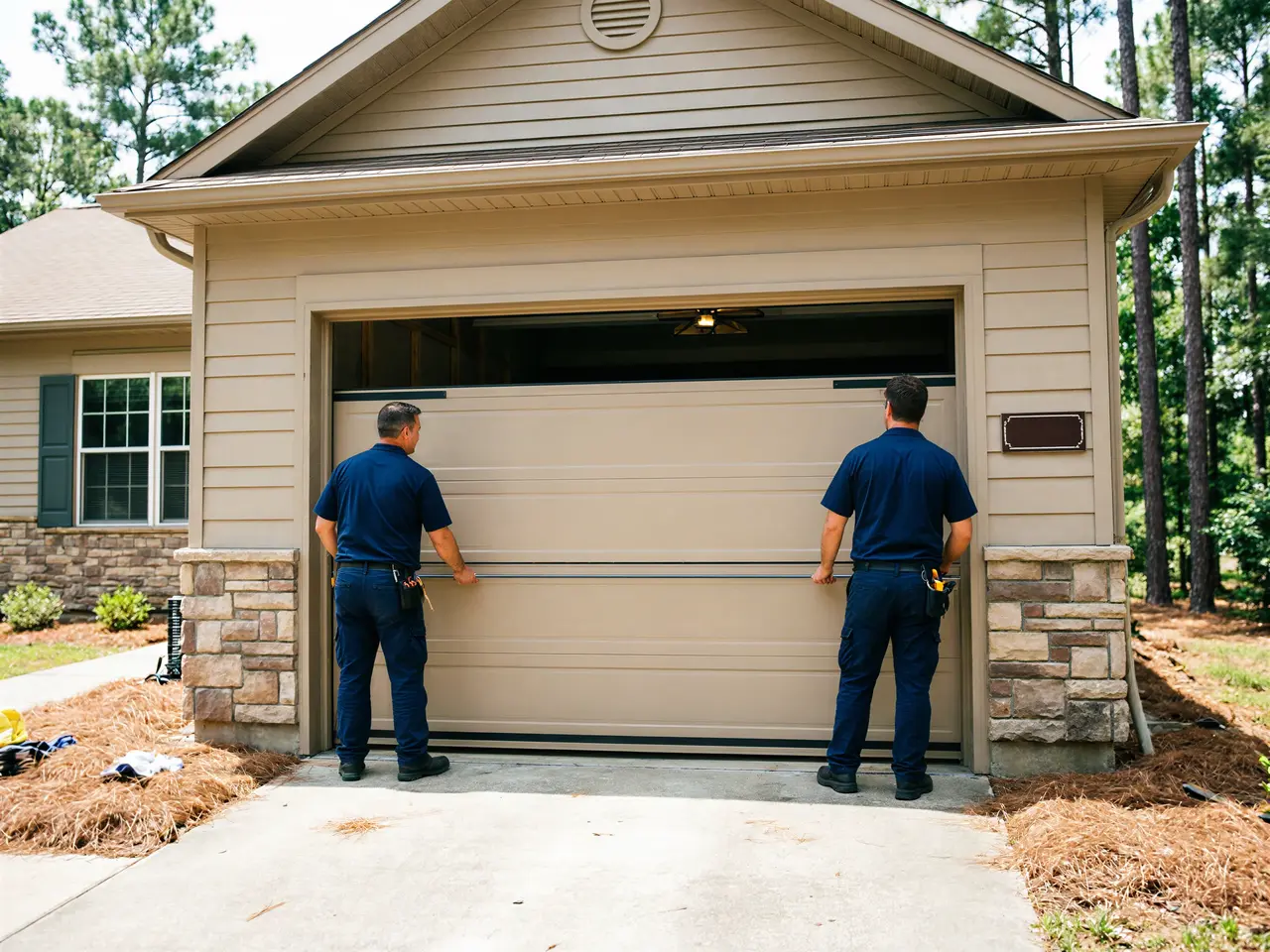
A cracked or dented panel looks like a weekend fix. Pull the old one, bolt in a new one, done. It can be, if your door is a newer sectional with panels still in production and you can match the color and ridge profile exactly.
The problem in this part of the metro is the age of the stock. Housing across the service area was mostly built between 1951 and 2007, with the bulk going up in the 1960s and 70s. A door installed when that house was built, or even a replacement door from the 80s or 90s, often came from a manufacturer that's changed its panel lineup two or three times since. The exact ridge count, the exact steel gauge, the exact hinge spacing may not exist on a shelf anymore.
You can order a panel. You cannot always order the right panel. Before you buy anything, pull the model plate off the inside of the door (usually top corner of a middle section) and get the full model number, not just the brand name. If that plate is gone or rusted past reading, you're guessing, and a guessed panel either doesn't fit the track spacing or doesn't match color enough to matter on a house you plan to sell.
The other DIY risk is the door's own weight once you remove a load-bearing panel from a torsion-spring system. The spring is still under tension. Taking a section out of a door that's still wound can let the remaining panels drop or rack sideways, and that's a hand or a back, not just a dented panel anymore.
Why This Fails Locally
Two things stack up here: the age of the doors and the climate band. This area sits in a cold-moderate zone, which means real freeze-thaw cycles through winter, not constant deep freeze but enough swing to matter. Steel panels on doors from the 1960s-70s build era are thinner-gauge than what's sold today, and they were never insulated the way a current door is. That thin steel contracts and expands with the swings, and over decades the seams between panel and frame work loose. A ding that would just be cosmetic on a thicker modern panel turns into a stress point that cracks along the seam in an older one.
Add in that a lot of these doors are original or near-original to houses built in that 1960s-70s window across the 23 named areas in this service territory. Original hardware means original panel stock, and original panel stock is the stuff that's hardest to match today. A single bent panel on a 1970s door isn't a cosmetic problem you can ignore - it throws the whole section out of true, which drags on the rollers and track next to it, and that wear spreads to panels that were fine a month ago.
This isn't a Riverdale-specific defect. It's what happens when a housing stock this age meets a climate with real seasonal swing, year after year, panel after panel.
The Cost of This Job
We don't have a price list to publish here, and we're not going to make one up. What we can tell you is what drives the number up or down on a panel swap: whether the panel is still manufactured (cheaper) or has to be special-ordered or color-matched by hand (slower and pricier), whether it's a single panel or the whole door is racked enough that we're really replacing two or three sections to get it running true again, and whether the hardware behind that panel - hinges, rollers, the end stile - took damage too.
Given a median household income of $67,872 across the service area, most of the calls we get on this job are homeowners trying to decide if a panel swap is worth it versus a full door replacement. That's a real question, not a sales pitch. If your door is old enough that panel stock doesn't exist, or if more than two panels are compromised, a new door often ends up costing you less aggravation than a patched one that still doesn't sit flush. We'll tell you straight when that's the case instead of ordering a part that's going to look wrong for the next ten years.
One honest limit: if your panel needs a hand color-match, we can't promise a short turnaround. Custom color work on old steel stock takes as long as the supplier takes, and that's out of our hands.
The Symptom
Here's what panel failure actually looks like before you've diagnosed it as a panel problem. The door runs rough on one side only, scraping or grinding right where the dent or crack is, even though the opener motor sounds fine. Daylight shows at a seam that used to be tight. One corner of a section sags a half inch below its neighbors when the door's fully down. The door reverses on its own partway through closing because the sensor at that height reads an obstruction that isn't there - it's the section itself bowing into the beam.
If you're only seeing cosmetic damage - a dent that doesn't affect how the door sits or moves - that's a lower-priority job and sometimes not worth doing at all on an older door. But once a panel starts pulling the track out of alignment, every cycle of the door makes the rollers and hinges next to it work harder. Across roughly 27,814 owner-occupied houses in this service area, most with doors from that same 1960s-70s-plus build window, this is the single most common path from "small dent" to "opener burned out" we see - not because the panel itself matters that much, but because of what it drags down with it.
Frequently asked questions
Can I replace just one panel on an old garage door?
Sometimes. It depends on whether the manufacturer still makes that exact panel profile and color. If your door is original to a house built in the 1960s or 70s, that stock may be discontinued, and you're looking at either a hand color-match or swapping more than one section to get a consistent look.
Why does my panel keep cracking at the same spot?
Usually it's a seam stress point, not the steel itself failing. Thinner-gauge panels from older doors flex more with seasonal temperature swings, and once a seam weakens, the same spot takes the load every cycle until it cracks again.
Is it cheaper to replace one panel or the whole door?
If only one panel is damaged and it's still in production, a single panel is cheaper. If the door is old enough that stock doesn't exist, or more than two panels are racked, a full door often costs less in the long run than patched repairs that never sit flush.
How do I know if it's the panel or the opener?
If the door scrapes or sags at one specific spot every time, and the motor sounds normal, it's almost always the panel or the track it's pulling out of line - not the opener. The opener reversing mid-close is often the panel bowing into the safety sensor, not an opener fault.
Related services
Book garage door service in Riverdale
Call now or request a quote - tell us what the door is doing and where you are.